Thursday, April 19, 2007
RIP
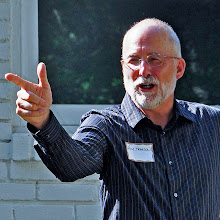
Much has been said, and much more will be said, about Virginia Tech. But no more needs to be said than this.

Thursday, March 29, 2007
Leave of Absence
Did I mention that I've given up the blog for Lent? I had to give up something; this seemed reasonable. (I also ate a lot of black beans and rice while Judy was out of town, but it's been more feast than fast since she got home from visiting the grandkids in Seattle.)
But fear not, dear non-reader. I shall be back once He is Risen (indeed!).
But fear not, dear non-reader. I shall be back once He is Risen (indeed!).
Saturday, March 3, 2007
Multitasking
There was an intgeresting piece on NPR's Weekend Edition Saturday this morning. It concerned a study that had been done to ascertain the effect of multitasking on learning (listen here). Surprise surprise, it turns out that kids who are seriously multitasking (that is, not just listening to music in the background) have significantly more trouble learning than those who are focused on the learning task. It turns out that for some reason, when a person is multitasking a whole different area of the brain is activated than when a person is focused on a learning task. The study also has implications for all who multitask, not just students. The guest suggests that while multitaskers experience the illusion of being more productive, it may well be just that -- an illusion.
None of this surprises me. I'm not one of these people with a blackberry in one hand, bluetooth attached to my ear, downloading music, IM-ing and the like while writing, say, a proposal or a direct mail letter. Nevertheless, there are so many things clamoring for a piece of my time that I find it very difficult to focus on any one thing long enough to finish it. My attention span is getting shorter and shorter. The quality of my work has suffered, my ability to complete a letter to a friend or a household task -- much less take time to meditate -- has suffered, and it takes me forever to finish a book. I'm not quite sure what this has done to personal relationships, but it can't be good.
If one is searching for a way to live sanely, this is not it.
Wednesday, February 28, 2007
For Now I See But Through A Glass Darkly
 This photo, mentioned by Tom Friedman in his column this morning (paid content), strikes me as a perfect metaphor for our world today. The gentleman on the right is the Israeli Defense Minister, Amir Peretz, inspecting troops on the Golan Heights. The "vision gaffe" was noted by the BBC.
It leads one to wonder: What did Peretz see? Sheer blackness? His own eyeballs? Or that which he had already made up his mind to see? Worth noting, too: apparently no one in the chain of command wanted -- or dared -- to point out the Defense Minister's mistake. Of course, it could never happen here...
Thursday, February 15, 2007
More Applause!
When I posted that last bit I had no idea that I was riding a wave -- or at least a wavelet -- but then I stopped by Greg Sandow's Blog today, and found him waxing enthusiastic over an article by Andrew Drukenbrod in the Pittsburgh Post Gazette a couple of weeks ago. Apparently this issue of applauding in all the wrong places is one on which reasonable musicians can disagree, though the tide seems to be turning in favor of spontaneous expressions of approval. Good. According to Drukenbrod, though, the Pittsburgh Symphony Orchestra knows where it stands. Using one of my favorite words, he tells us that "tucked away on the penultimate page of Pittsburgh Symphony Orchestra programs" is the following:
In a multi-movement work, it is customary to wait until the end of the last movement to applaud, so as not to break the concentration of the performers.
But as for the performers themselves... well, you can read the article. It comes replete with musical examples which reinforce my point about the intent of certain composers, by the way.
I swear hadn't read any of this before. I must have been touched by the zeitgeist of these changing times.
Sunday, February 11, 2007
Applause!
This afternoon Judy and I made the trek into Charlotte to hear a performance by Joshua Bell, accompanied by Jeremy Denk. There are several things that might be said about this: that their performance was first rate (I only nodded once, for a split second); that they all but filled the hall, which almost never happens with the bluehairs of the Carolinas Concert Association; or that the program notes were downright bizarre in places, as for example in the following regarding the Concert Piece for Violin and Piano by Edgar Meyer: "Mr. Meyer is a frequent partner of Mr. Bell in the arcane (?!) art of bluegrass music, and perhaps this is the reason the violinist felt the need to introduce this work" (my, aren't we condescending).
But what struck me was the applause.
First on the program was Robert Schumann's Sonata No. 1 for Violin and Piano in a, Opus 105. A sizeable number of the audience applauded lustily after each movement. Beethoven's Sonata No. 10 for Violin and Piano in G, Opus 96, followed. The audience applauded after the first, third and fourth movements. No doubt they would have applauded after the second as well, but there is no break between the second and third movements.
After intermission, the duo played the piece by Edgar Meyer (a serious contemporary work in which one would have had to listen very hard to hear even a passing reference to bluegrass, by the way), and their was no applause between movements, but lusty applause with bravos and a standing O at the end.
I saw some of the bluehairs around me wincing at the applause in the "wrong" places. And I wondered, What's going on here? Did these two rock stars of classical music attract a group of relative youngsters who haven't been properly trained (indoctrinated?) in classical music etiquette? And yet, how to explain the lack of applause during the Meyer? At first I thought it might signal dislike, but the enthusiastic response at the end of the piece put that idea to rest.
Actually, I can't escape the suspicion that this untrained audience responded the way the composers themselves intended. The applause-provoking movements of the Schumann and the Beethoven ended with dramatic flourishes and a full stop. How could you write such an ending to a section and not expect people to react? The oddity to me is not that people would applaud at such a point, but that they wouldn't. When Beethoven didn't want applause, he made an entirely different type of transition between movements.
As for Edgar Meyer, each movement save the fourth of today's piece ended quietly, almost tentatively -- seemingly reaching out toward the next. Applause would have seemed strange, had there been any.
My conclusion is that this audience, or at least the "untrained" members, understood with their guts what's been bled out of concert goers for many decades -- that the composer and the artists are putting on a show, and they jolly well want you to enjoy it. If you are moved to demonstrations of enthusiasm, who's to say that's a bad thing? Lord knows, classical music needs all the enthusiasm anyone can muster these days.
Oh, and one other thing: Jeremy Denk has a great blog called Think Denk. Have a look.
Sunday, January 28, 2007
Blights on the Landscape
 The other day I ran into my friend Larry the Art Professor in front of the Visual Arts Center (VAC) at Davidson College. The radio station where I work is just up the street. A couple of days earlier I had received a phone call from the secretary in the art department asking whether we had installed a new antenna on top of the VAC. "We installed one about four years ago," I said. "It's a microwave dish for our studio-transmitter link." I had to admit that I had never actually seen it, though I had walked past hundreds of times. I said that if there was another, more visible, antenna that appeared recently, it must belong to someone else.
When I ran into Larry, I said something light hearted about antennas on the VAC. He seemed unamused. He pointed to the building. "That has no place on this building," he said, pointing toward the rearmost of three large circular objects on the roof. Straining my eyes, I finally saw it: a microwave dish perhaps one meter in diameter just peeking out over the rim of the circular structure. It was ours, I had to concede.
I pointed out, though, that the dish had been there for some four years before he himself saw it. "Beside the point," he snapped. "You should take it down." I told him that if we took it down we'd go off the air." He seemed unpersuaded, and still more annoyed. "People think that architecture isn't art," he said. "Would you put an antenna on top of our Rodin?" I said of course not, but the cases didn't seem comparable. The antenna on the VAC was barely visible, to the point that most people -- including Larry until a few days earlier -- had never seen it.

"Put it on top of your own building," Larry said. We can't do that, of course. We would have to build a 75 foot tower next to the building, a true eyesore. But this didn't cut it with Larry. The VAC, he told me, is a piece of architecture, designed by a world reknowned architect. Whereas our building is just, well, a house designed to look like the other houses on that rather historic street. The architect isn't world reknowned. Who cares what happens to, or near, such a building? (Tut tut. Are we being just a tad elitist?) I pointed out to Larry that antennas are so ubiquitous that one finds them bristling from the crowns of tall buildings everywhere, those that are considered landmarks of architecture as well as more prosaic structures. He was unconvinced. "Antennas on fine buildings are designed to complement the architectural elements of the building," he told me. Sure they are, when they can be. When that's not feasible, though, the antennas still go up. Our modern world demands them, can't live without them.
The irony of all this is that Larry and I are on the same side, philosophically. I hate what has happened to the landscape. There is no direction you can turn without seeing some kind of antenna. I remember well how communities first reacted when cell phone towers started sprouting everywhere. They were outraged. But you can't walk around with a cell phone planted in your ear without a bunch of towers around to transmit your calls. In the end, people wanted their cell phones -- and all the other wireless appurtenances of modern life -- more than they cared about their views.
But at a certain point I've got to say, "Come on, people, get a life." If you're going to get all exercised over an antenna, at least make it one that the average person can see with the naked eye. OK? A sense of humor wouldn't hurt, either. I mean, you might at least consider an antenna for the Rodin. It might improve cell phone reception, or wireless computer connections, in the building. That's what the students really care about, you know.
Subscribe to:
Posts (Atom)